Calormen
The Horse and His BoyCalormen is the southern kingdom in which Shasta’s story begins and from which he and Bree seek freedom. Presented through the contrast between imposed service and the free lands beyond its borders, it is both the setting of Shasta’s early life and the power whose military designs bring the fugitives’ journey into the larger conflict over Narnia and Archenland.
Setting and Shasta’s Early Life
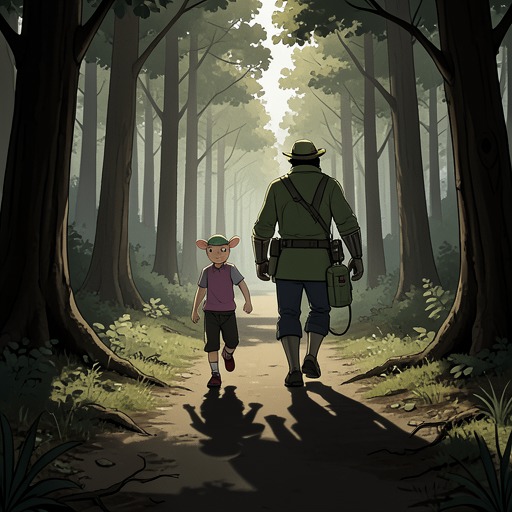
Calormen lies south of the lands the fugitives hope to reach. Shasta lives with Arsheesh, a poor fisherman, in a cottage beside a small sea creek. Arsheesh fishes, sells his catch in a nearby village, and expects Shasta to do much of the household work: mending and washing nets, preparing supper, and cleaning. When sales go badly, Arsheesh finds fault with the boy and may beat him. Shasta’s home life thus combines labor and dependence with a future he knows little about.
The north occupies Shasta’s imagination precisely because he is not allowed to go there. From the cottage he can see only a grassy rise, a ridge, and the sky beyond, but that restricted view gives direction to his curiosity. The village to the south seems uninviting; the unknown country northward becomes the possibility of another life. Arsheesh discourages questions with either anger or a proverb praising application to business, reinforcing the limits placed on Shasta’s knowledge and movement.
Hierarchy and Enslaved Service
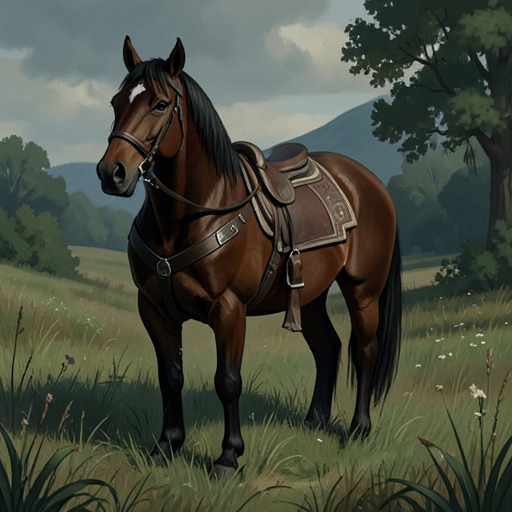
Shasta’s experience is not identical to Bree’s, but both are shaped by a society in which human owners control others’ labor and movement. Bree, a talking horse from Narnia, says he was captured as a foal after straying south into Archenland and beyond. He has spent years enslaved by humans, concealing that he can speak and pretending to be an ordinary, unintelligent horse. He believes discovery would have led to exhibition and tighter confinement, so silence became part of his survival.
The narrative also connects the treatment of horses to the hierarchy’s broader assumptions. In a discussion of whether Narnia should be conquered, Rabadash speaks of punishing it as one might hang an idle slave or dispose of a worn-out horse. His comparison reduces both people and animals to instruments subject to their masters’ decisions. Against that worldview, Bree’s escape and his insistence that a free, talking horse must not steal register freedom not just as escape from a particular owner, but as a changed moral responsibility.
Escape, Route, and Military Threat
Calormen’s geography has a double role: it is the country from which the fugitives flee, and a territory whose desert routes shape the threat to its northern neighbors. Sallowpad the Raven explains that the Great Oasis cannot sustain a large invading force and its animals. A different route begins at the Tombs of the Ancient Kings, heads northwest with Mount Pire’s double peak in view, and descends a narrow, difficult-to-find valley to a river leading into Archenland. The possibility of that passage makes detailed knowledge of terrain consequential to the kingdoms’ security.
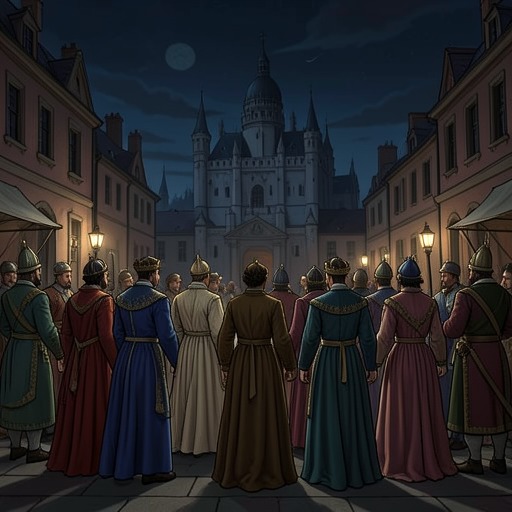
Rabadash proposes exploiting the route for a surprise attack. He plans to take only two hundred horsemen across the desert, seize Anvard before its defenders are ready, pass through the route above the castle, and continue through Narnia to Cair Paravel. He expects to find the High King absent and hopes to wait there for Queen Susan’s ship, then carry her back to Anvard. The Tisroc hears the proposal as a way to pursue conquest while distancing himself from the risk of an openly declared campaign. Calormen’s political power therefore reaches beyond its own territory through a plan that turns the desert from a barrier into an avenue of attack.
The Desert Crossing and Defeat at Anvard
The escapees’ crossing shows the physical limits of travel through the desert. At a brief halt beside a rock outcrop about fifty yards long and thirty feet high, the group crowds into its small shade, eats, and drinks only a little water. Bree and Hwin manage to drink from a skin bottle, but no one has enough. The party resumes its journey and continues searching for the hidden valley, making the route’s promise inseparable from exposure, thirst, and exhaustion.
Rabadash’s campaign reaches Anvard, where his men attack the castle gate with a tree trunk as a battering ram. When the Narnian force appears over a ridge, the attackers remount to meet it. The defenders then sortie through the opened gates; King Lune and his men join the fighting, while the Narnian forces press the attackers from several directions. The Calormenes are ultimately defeated, and the surviving men visible to Shasta are prisoners. The failed invasion reveals the consequence of treating neighboring free kingdoms as easy objects of conquest: the route enables surprise, but it does not secure victory.
Narrative Significance
Calormen’s role in the story is defined by contrast and connection. Shasta’s restricted childhood and Bree’s concealed identity establish the costs of dependence, while their northward escape gives the narrative its initial movement. Later, the same country’s rulers and military plans connect that personal flight to the defense of Archenland and Narnia. The desert binds these strands together: it is an obstacle the fugitives must endure, a landscape whose hidden passage can be learned, and the corridor through which Rabadash attempts to extend Calormen’s power.